By Marley
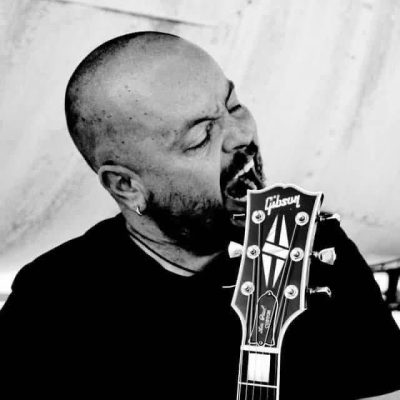
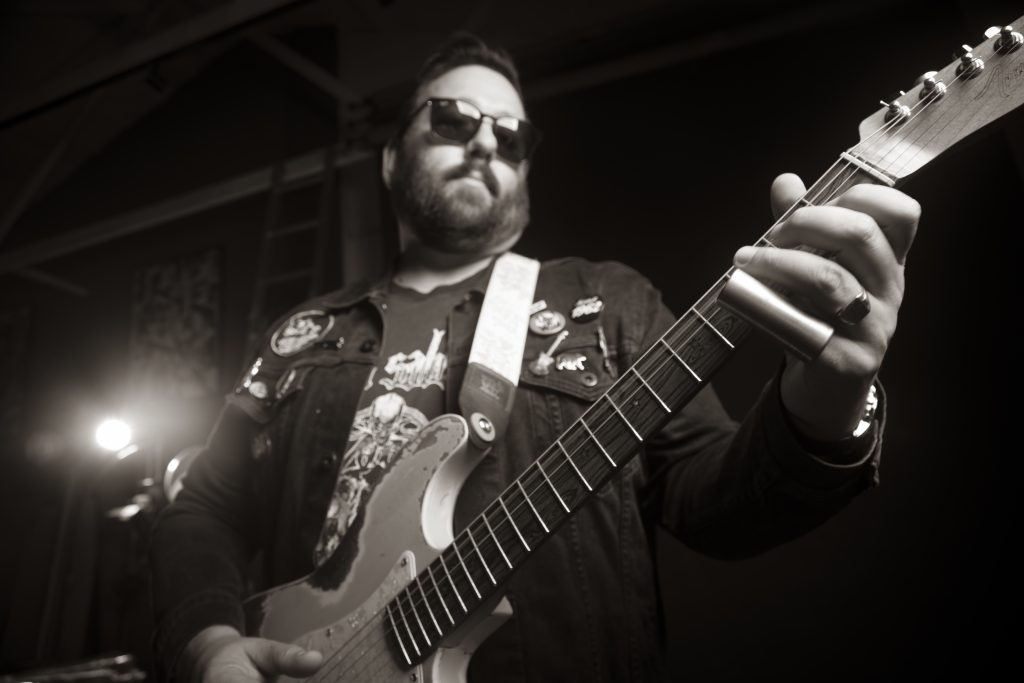
In the tranquil, tree-shaded streets of Stellenbosch, you’ll find a guitar master hiding in plain sight. Stratocaster slung over his shoulder, badges on his jacket worn proudly and a blues-rock artist, one of our best. I’m talking about Basson Laubscher.
I’ve been honoured to know Basson since Zinkplaat days on the Avontoer bus, which was a six-year journey for many bands. After Zinkplaat called it quits after ten years in the industry, Basson started a passion project – The Violent Free Peace. And as any good guitar slinger, he played and still plays with some pretty nifty guys (and girls) – Valiant Swart, Ryno Velvet and Ann Jangle. But Basson isn’t just a guitar slinger that makes the Fender weep. Oh no, he preaches about soulful nights, hidden lust and love found in places. His songs paint a story and leave the rest up to the listeners.
I had a chat with the SAMA-nominated Basson over the phone; we even featured him on Musiek Momentum (episode 24), and I realised how much this guy has to say. Of course, we had to start with the band name, given I have never seen him with the same band members over the years.
“The band name was specifically chosen so that we can go through line-up changes. There is always a sad part of when someone must leave. But at this moment I’m very excited about our solid, rock ‘n roll machine. We have Adriaan Jordaan on drums and Steffen Jacobs on bass, and Riaan Nieuwenhuis is always on the keys.”
In the past, we have spoken about the cost of recording, which you can imagine can be a very high bill. I’ve been informed about studio costs from a range of artists – big and small – and let me tell you, it can be expensive. But it has been a while since that last album, Testify, and there was a vinyl print of said album but its sold out.
“The plan is to bring out an album and EP in the next two years. We are busy with recording as a four-piece right now.”
But with the talks of studio time comes the talk of the moment – AI and its influence. “It’s a double-edged sword,” says Basson when I ask about his feelings towards AI and its uses in the current music scene.
“I feel personally there is a gap for it here and there, but not for the creative role. A person can use AI to help find a process for the mixing, mastering and to help spark the creative side of a person. But it should not take over your creative side completely. Art comes out of struggle and putting in the hours. If you know how to write, the song structure and how melodies work, then yes, AI can help with that. If you are an independent artist, then AI can help you with admin, graphic design, and sound engineering.
“But it is not a songwriter; that is a human connection.”
Personally, I feel that AI can be used in certain ways to make you hear what a song can sound like, but it shouldn’t ever, ever replace the human. Because you still need a human to perform the song. And this is where the next part of our conversation went: what is the biggest challenge currently in the music industry?
“I think the biggest challenge is worldwide. The fact that music is a non-commodity and the fact that people’s attention span has shrunk. The internet became a paywall, which we will start to feel much later on.”
He continues: “So, from my side of the industry, which is alternative, it’s always been small and not an easy industry, but it has shrunk as well. Everyone is basically fighting for the same small audience. Also, we sit with the world’s entertainment at our fingertips and TVs, no one really wants to go out anymore and a lot of it is free. It’s easier to hang with your buddy at home than to go out for some live music. I can understand where people come from because no one invests in watching a live band anymore.”
And we return back to AI.
“With the rise in AI, now anyone can make music, and that will change a few things drastically in the future. The old-school music lover and the art supporters is now a niche and old breed, which is a small percentage. The kids growing up now are not growing up with that nostalgia or the experience.”
It’s also a financial thing and as I experienced in my own town, a lot of venues have either closed down or struggle to keep doors open, never mind having live music around.
“The main issue currently is that we are losing money, venues are closing, and artists struggle as platforms like radio and TV are just not there as it was in the past. Streaming platforms are simply overrun and pay peanuts. I say as an artist, we should invest in our niche market and the real human interaction. To keep building the community.”

I must admit that despite doing a 30-minute max radio programme, it is getting harder and harder to get people to listen to new music, never mind established artists. I know how fantastic Basson is live and no one plays guitar like he does (there are many that try), but how do we get new music to the people? What will convince you, as the reader, to go and follow an artist or band you have never heard of? We have so much talent in this country, it’s ridiculous.
I asked Basson about his current influences. “Currently my strongest inspiration is Marcus King, McKinley James and Pokey LaFarge” – all artists you should be listening to if you are a blues man… or girl.
We return to the conversation about costs and touring, as a band takes up a lot of money really quickly. Musicians have costs as well as human beings – insurance, guitar strings, medical aids (many artists I know can’t afford medical aids), families, cars, fuel costs and so forth. Many think that being a musician means you have a lot of money or that popularity makes it easier. Maybe, but to tell you the truth, it costs a lot more than that.
“I have no label or financial support, and it’s become costly to fly or drive, in fact. People our age now have day jobs and can’t take leave for four weeks to go on tour; it doesn’t make sense to do that anymore. The model of touring has changed so fast and so dramatically that unless you get into a larger festival that is willing to pay your fees, then sure. But never say never; it is difficult to tour outside of the province.”
We lighten the mood a bit and talk about places he loves. “There definitely are places I love and won’t name because I might forget the name or somebody, and then I feel bad. But there are gems in our country, venue owners, the crowd and the sound that makes it all part of a beautiful package.”
Listening to his last album, Testify, I always wondered about the sound of Testify. Where did the inspiration come from?
“Testify is my tribute to the spirit of rock ‘n roll. Music will always bring me back no matter how tired I am, or I think I must put down the guitar. In some format it just brings me back. I’m not a big believer in faith, but the magic of music is my faith, and that is something to write about.”
Despite the challenges that Basson faces, like many artists in the country, he still actively gigs in and around the Cape, and you will never not see him play guitar. Unless he has a beer in his hand, which is another passion project he promised us he will talk about later. All we can say is it’s blonde, and it’s a bar, and it’s going to be good. Why not? We are a country that loves our beer, drinks all round.
You can have a listen to Basson’s Spotify, follow him on Facebook for the latest tour dates, don’t forget about Instagram or watch some of his cool videos, like “Bonnie & Clyde”, which is another favourite. We promise to load up our Musiek Momentum episode of Basson as soon as we get it from the masters.
Until then, play some dirty rock ‘n roll.